Patricia Benner, MSN, R.N. Ph.D., FAAN.
John Benner, Ph.C., University of Washington, Seattle, WA.
Montana Sim Files Focus Area: SimulationDr. Benner and the Educating Nurses Team spent a week touring the Montana State University Mark and Robyn Jones College of Nursing, and were able to observe and record their revolutionary use of simulation across all 5 campuses.
This article highlights the 3 main innovations in simulation lab pedagogy Dr. Sarah Shannon and her faculty have developed. As you read, keep an eye out for links to our 7 new videos for more detailed information. Whether your program has a strong sim practice, or your use of simulation needs development to meet its potential, these videos will provide excellent information and inspiration!
The faculty at The Mark and Robyn Jones College of Nursing, Montana State University have pulled off a major feat bringing the learning objectives of the entire curriculum for both classroom and clinical rotations together in a School-Wide Simulation Course that spans the 2 years of the program. What makes this feat all the more impressive is that this college of nursing spans 5 campuses, and all students have the same access to this excellent simulation pedagogy! Dean Sarah Shannon led the faculty in designing the Simulation Lab Course to integrate learning across whole curriculum.
Previously nursing professors at MSU assigned hours in the simulation lab according to their instructional goals and personal comfort level with running simulations. Students within the same college location were not getting equal access to simulation based learning, and this was even more uneven across all 5 college locations. Instructors would send students to the sim lab to practice skills like IV insertion or patient interviews, but there was no consistent practice or philosophy about how and when the simulation labs should be used to maximize student learning and practice readiness. Dean Sarah Shannon and her faculty worked together to make better use of their simulation labs and turn them into a consistent cornerstone of their nursing program.
In our observations of this program, we observed 3 major innovations that stood out in the creation of a dedicated Simulation Lab Course track.
Innovation 1: 2-year, 1 Credit Simulation Lab Course Completely Integrated with Course Curriculum
Dean Sarah Shannon, MSU Mark and Robyn Jones School of Nursing
The first major innovation was to make a dedicated 2 year simulation lab course track where the content of the simulations would reinforce the learning objectives from the science and clinical coursework. To do this, the Simulation Course design team looked at the syllabi for courses for each year, along with the designated clinical rotations and created a simulation schedule that would integrate and contextualize what students were learning in courses like physiology with clinical coursework. This meant changing when some topics were taught in the science or nursing coursework or clinical rotations so that topics reinforced one another across coursework, clinic and simulation classes.
These simulations are whole case scenarios, not just a skills practice lab. While skill labs are still part of the curriculum, they are different than simulations. These immersive simulations use manikin or standardized patients, and require concrete skills like IV insertion, or cognitive assessments, but include other factors that go into continuing care for a patient, such as co-morbidities, medication adjustments, and patient and family education. Students rotate in groups of 4 through the simulation to simulate the progression of a particular case either through the day or even months of care. They observe and learn from one another as each group progresses through the Sim. Every skill students practice in simulation occur in the context of applying knowledge and skill to understand when and why they as a nurse would take one course of action over another. These kinds of whole case comparable experiences are critical for nurses to build a repertoire of experiences that is the foundation of solid clinical reasoning.
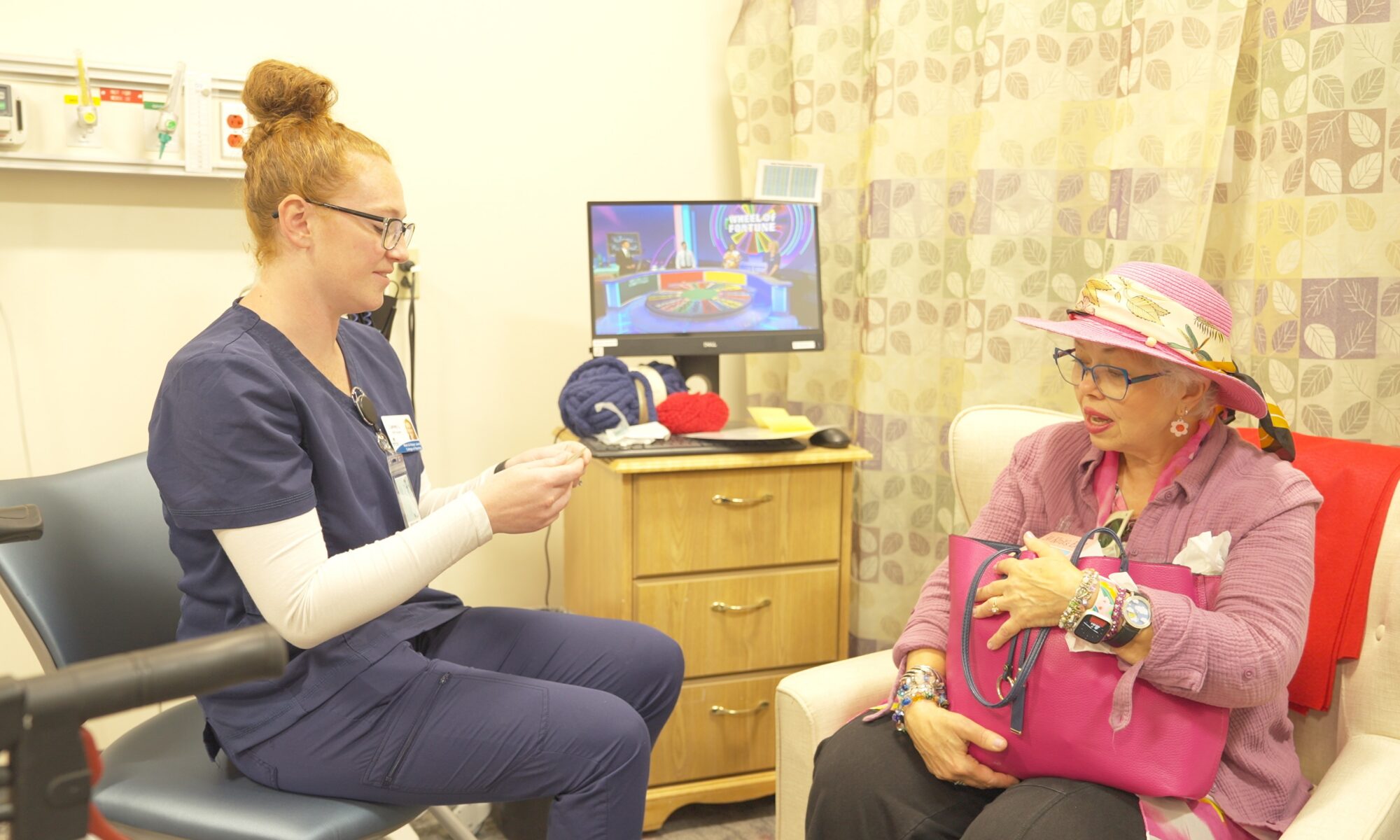
The Montana State University students are quick to give the Simulation Course accolades for “integrating the learning” in all the science, clinical, and nursing classes. Students highly value practicing real, complex clinical assignments. While many simulations are run using manikins for patients, model patients are also used. One session we observed included a retired faculty member acting as a model patient. Retired faculty have a fund of background experience in caring for patients. For example, we watched one former professor in the role of an older “patient” assigned a diagnosis of dementia, and she came complete with a large purse full of items, some of which were unsafe for her to have, and the students had to practice tactfully getting those items back. This choice came from her experience caring for patients with dementia, and when this “patient” was seen again, she knew how to make believable deteriorations in her presentation.
Innovation 2: Highly Trained Simulation Faculty and a Culture of Continuous Improvement
Prior to the College’s design of the Simulation Lab staff had no consistent training in how to use simulations in instruction and professors used the labs as best they could. The first thing that needed to happen was better preparation in the pedagogy of clinical simulation. The faculty who taught in the simulation labs across all 5 campuses had extensive training in simulation based instruction from the Harvard Center for Medical Simulation. A core group of faculty took Harvard Medical Simulation training prior to the design of the simulation lab course and year by year more faculty became trained. Now there is a sufficient knowledge base among the faculty to provide their own simulation instruction trainings as part of onboarding new faculty.
Highly trained simulationists working closely with other nursing faculty have the added benefit of being knowledgeable enough to tailor each week’s simulation to the learning needs of the students. In addition to the trained simulation faculty, the college also uses current and retired professors as standardized patients because they have found that these experienced educators can strategically adjust their acting to target issues of practice and other learning goals for these students. We observed both simulation instructors and standardized patients modify their performance live in the sim to better meet student learning needs.
Innovation 3: Creating A Culture Of Learning and Care
“The Basic Assumption”
“We believe that everyone participating in activities at the Mark and Robyn Jones College of Nursing is intelligent, capable, cares about doing their best and wants to improve”
-Sign on the walls of each Simulation Lab classroom
“(Mistakes) are a puzzle to solve. It’s not a crime to punish.”
In our observations of this program we were surprised at the warmth and enthusiasm for learning in the Simulation Lab classrooms. This didn’t just happen by chance! The emotional tone and teaching style of simulation instructors was intentionally designed so that students could learn with and from one another. Nursing is a highly demanding field where lives are literally on the line. Unfortunately many nursing classrooms take this to mean students must experience that kind of pressure from day 1. While the intent in these high pressure classrooms is to prepare students to handle the pressure of the real world, learning research shows that people do not learn well in high stress environments (Bruce et al., 2010; National Research Council (U.S.) & National Academies Press (U.S.), 1999). Students living in fear of failure take few risks and try to hide their mistakes rather than learn from them. The Simulation Lab design team took this reality to heart. The Simulation Lab classroom climate was refreshingly calm, warm and engaging. Rather than treating mistakes as evidence of failure, faculty and students treated them as precious opportunities for learning. It was not enough to observe a mistake, but to get at the misunderstanding that led to this mistake. This resulted in a learning environment where students felt safe to take risks and ask questions to drive their learning. This was not an accident, but a result of training and living up to the expectation of the sign quoted above. Students were given observation protocols and trained in giving and receiving feedback. The Sim Classes usually consisted of 12 students all of whom watched and commented on each of their classmate’s simulated clinical case.
Each Sim Lab class we observed followed a basic structure: Prebrief and Orientation to Practice, Simulation, Debrief.
Prebrief: The prebrief materials and conversations prepared students for the specific clinical situation they were facing, but also included eliciting the prior knowledge from coursework and recall of relevant clinical experience. The prebrief was also an opportunity for instructors to guide students in their formation of their identity as nurses, and the ethical and professional comportment nurses need. Students participated in simulations in different roles in groups of 3 or 4, ranging from patient, medical assistant, family member, nurse and charge nurse. Clinical scenarios built off one another for each rotation of 4 students so that they could see the course of treatment that might take place over a day or several days. For example, different groups of students in the first year cohort we observed had to make different medication decisions based on the vital signs of the patient. This is consistent across simulations. Students made comparisons between variations in the clinical scenarios and the clinical reasoning required to meet the changing patient needs across time and across changing clinical conditions.
The consensus of nursing students was that their simulation experiences, including debriefings, were open and honest, but not Judgmental. The debriefing sessions, as we observed them, were non-threatening, and relaxed. During debrief, students shared feedback with one another in addition to receiving feedback from the instructors. Debrief also served to make the clinical reasoning each student did more visible to one another as students articulated their thinking behind particular decisions in the sim. Frequently students requested and repeated their clinical simulation to improve on their nurse-patient communication, actual assessments and/or their clinical reasoning and patient care.
Conclusions:
Dean Shannon and Faculty (See Shannon and Benner Video Taped Interview EducatingNurses.com October 24, 2025) described the well-known problems with clinical learning occurring in busy clinical units: 1) the down time from lack of patient availability; the variable complexity of the patient-nurse communication; the level of direct patient care required for complex patients; the difficulties of matching students with specific complex patient care treatments during the student’s assigned clinical time, and more. Highly integrated clinical simulation courses solve these clinical access problems. The highly trained simulationists at MSU are able to tailor sim experiences on the fly to meet individual student needs and even adapt simulations between student groups to effectively model the course of care a patient might have. Students observing one another in the sim also serves as an additional reinforcement of the learning. Students recognize they learn a great deal from peers as they give feedback and go through the sims themselves.
Simulation is not new, it has been around for a long time, but often, in nursing schools, it has been used to teach isolated clinical skills such as resuscitation for a patient with a cardiac arrest, or simpler singular skills such as inserting a urinary catheter, or placement and management of administering intravenous fluids. While teaching of isolated clinical and highly technical skills will continue to occur in skills lab classes, MSU’s School of Nursing’s Simulation class was planfully integrated into The Nursing School’s curriculum, with learning objectives coming from each course.
Such a highly integrated clinical Simulation Course is urgently needed in all schools of nursing to help nursing students integrate learning from each course and to graduate with a higher degree of practice readiness (Chan & Burns, 2021;Kavanaugh & Sharpnack, 2021; Kavanaugh & Szweda, 2017).
Students at The Mark and Robyn Jones College of Nursing, Montana State University Montana are enthusiastic about their learning in the Simulation Classes. They describe their clinical learning in simulation as essential to their nursing education. We hope you enjoy these videos and hope to hear questions or insights about the use of simulation in your settings.
References:
Bruce, M., Omne-Pontén, M., & Gustavsson, P. J. (2010). Active and Emotional Student Engagement: A Nationwide, Prospective, Longitudinal Study of Swedish Nursing Students. International Journal of Nursing Education Scholarship, 7(1). https://doi.org/10.2202/1548-923X.1886
Chan, G.K., Burns, E.M. “Quantifying and Remediating the New Graduate Nurse Resident Academic-Practice Gap Using Online Patient Simulation,” Journal of Continuing Education in Nursing. 52(5) 240-249. 2021;52(5):240-247. doi: 10.3928/00220124-20210414-08.
National Research Council (U.S.) & National Academies Press (U.S.) (with Bransford, J., Brown, A. L., & Cocking, R. R.). (1999). How people learn: Brain, mind, experience, and school. National Academy Press.
Kavanagh, J.M., Sharpnack, P.A., (January 31, 2021) “Crisis in Competency: A Defining Moment in Nursing Education” OJIN: The Online Journal of Issues in Nursing Vol. 26, No. 1, Manuscript 2.
Kavanagh, J.M., Szweda, C. “A Crisis in Competency: The Strategic and Ethical Imperative to Assessing New Graduate Nurses’ Clinical Reasoning.” Nursing Education Perspectives VOLUME 38 NUMBER 2. 2017 pp. 57-62. National League for Nursing
Montana Sim Files Focus Area: Simulation© Mark and Robyn Jones College of Nursing at Montana State University, Bozeman.